
If you are taking IELTS in Singapore, you usually have a clear reason.
Maybe you need it for a university offer, a visa, or a professional requirement.
You may also feel stuck.
You hear people say “just take an IELTS course” or “learn the tricks”. But you are not sure what IELTS really tests, what score you need, or how long it will take.

Who this guide is for
when IELTS is worth taking (and when it is not)
the first decisions to make before you book
how to choose the right prep route for your timeline
Who this guide is for:
This guide is for you if:
For a specific requirement
you need IELTS for overseas study, immigration, or a specific job requirement
You are in Singapore
you are in Singapore and deciding what to do next (book now, prepare first, or improve your English level)
This guide is probably not for you if:
you do not need IELTS for any requirement and only want a high band “for prestige”
What IELTS is (and what it is not)
IELTS is an English test.
It checks four skills: Listening, Reading, Writing, and Speaking.
It is mainly used for:
Tertiary studies
university, postgraduate programmes
Immigration
Some countries and visa types
Some professional bodies
for licensing purposes

IELTS is not an “English course”.
A good IELTS prep plan teaches exam skills. It helps you use your English better under test conditions.
But it does not replace real English improvement.
If you do not need the test for admission or immigration, you may get more value from improving your English for work and daily life in Singapore.
The first question to answer: what is your target band?
If someone tells us “I want IELTS”, the first question we ask is simple:
What is your target band, and when is your deadline?
Many people cannot answer this.
They know they need “IELTS”, but they do not know the required band score.
What does a band score mean?
IELTS uses band scores from 0 to 9.
Most people aim for bands like 5.5, 6.5, or 7.0.
Two details matter:
- overall band (your average score)
- minimum scores per skill (some schools want, for example, no skill below 6.0)
How IELTS bands roughly map to CEFR levels
Some schools and employers also talk about CEFR levels (A1 to C2).
CEFR is a level scale from the Council of Europe.
IELTS and CEFR are not the same system, so there is no perfect conversion. See [IELTS and CEFR].
But as a rough guide, many organisations use this alignment for overall band scores:
- IELTS 4.0 to 4.5: around B1
- IELTS 5.0 to 6.5: around B2
- IELTS 7.0 to 8.0: around C1
- IELTS 8.5 to 9.0: around C2
Use this only to understand the “level” behind a band score.
Always follow the IELTS band requirement written by your university, visa authority, or professional body.
How to find your required band
Start with the organisation that is asking for IELTS.
Use this checklist:
- University or course page: check the required overall band and the minimum for each skill (see [example: UBC’s IELTS requirement]
- Immigration or visa pathway: check the exact IELTS type and minimum score rules (see [Express Entry language test requirements]
- Employer or professional body: check their written requirement
If you cannot find a clear requirement, ask the admissions team or agent and get the answer in writing.
Common examples (only examples)
You will often see targets like these:
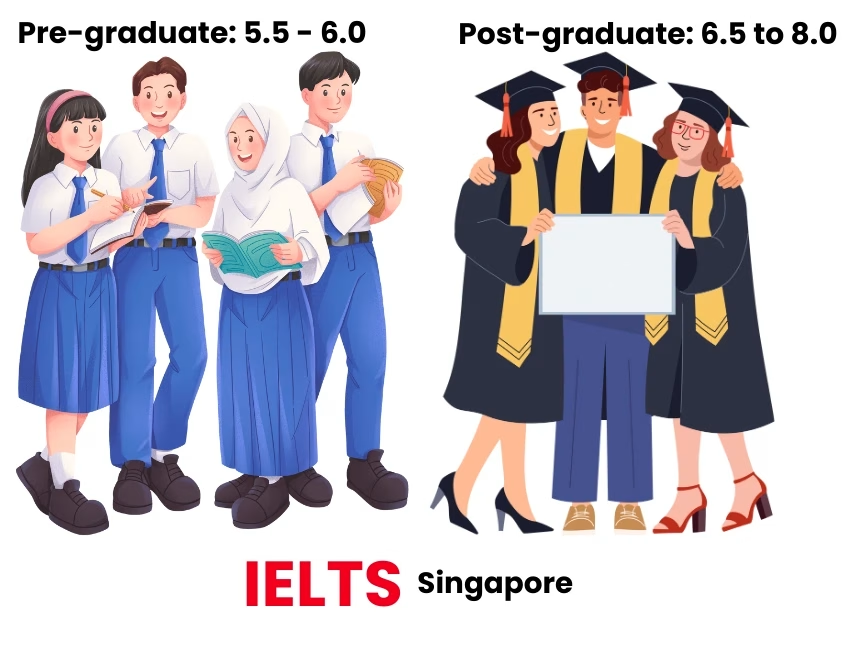
- degree programmes: around 5.5 to 6.5
- master’s programmes: often around 6.5 to 7.5
These are only common ranges.
Always follow the exact requirement for your school or pathway.
Myth check: the three most common mistakes
People waste time and money on IELTS for the wrong reasons.
Here are the most common myths.

IELTS prep is an English course
IELTS prep focuses on test tasks.
It helps you understand the tasks, manage time, and avoid common exam mistakes.
If your English level is still weak, you also need to work on your language skills. That means vocabulary, grammar accuracy, clearer sentences, and more speaking and listening practice.


Myth 2: “Exam tricks can help me jump many bands”
Exam skills help when you are already close. For example, you may have the level, but you lose marks because you misunderstand the task, write off-topic, or manage your time badly.
But if your current level is far below your target, “tricks” will not carry you.

Myth 3: “I need a 7.0 or 8.0 because it sounds good”
Some learners chase a high band as a label.
This can be risky if your current level is much lower.
A better goal is:
- the minimum band you need for your plan
- plus a small buffer if the timeline allows

Reality check: your current level vs your target band
Your target band is only half the plan.
The other half is your current level in each skill.
Many adults in Singapore have uneven skills.
For example, you may read well, but struggle with Writing or Speaking because you have not done academic tasks in years.
Why your level matters more than your practice test score
A practice test score can be misleading.
You might score well in Reading, but still miss the Writing and Speaking targets.
For IELTS, you do not only need “English”.
You need the right English under time pressure, with specific task rules.
How long does it take to improve?
This depends on:
- your current level
- your target band
- your weakest skill
- how many hours you can study each week
A simple way to think about it:
- If you are close to your target, focused coaching and practice can help within a few weeks to a few months.
- If you are far from your target, you may need months of English building before exam coaching really helps.
We sometimes use [hundreds of hours] as a rough illustration.
Not as a promise.
For many adults, moving more than one band usually needs sustained study and feedback.
A simple first step before you plan
Before you pay for many prep sessions, do two things:
- find out your required band and deadline
- take a [level check] that looks at all four skills
If you are not sure of your level, a short online level test can help you start.
What IELTS preparation actually looks like
Good IELTS preparation is practical.
It is not just “do more practice papers”.
A good plan usually includes:
- understanding task types and marking criteria
- timing practice (so you finish all tasks)
- strategy (how to approach each section)
- targeted correction (so you stop repeating the same mistakes)

What this looks like for Writing
For many working adults, Writing is the hardest.
Not because they have “bad English”, but because they have not written in an academic style for a long time.
Typical focus areas:
- clear structure (introduction, main points, conclusion)
- formal tone and precise vocabulary
- grammar accuracy (small errors can lower your score)
- task response (answer the question directly)
What this looks like for Speaking
Speaking problems are often about habits.
For example:
- giving short answers
- pausing too long because you translate in your head
- repeating basic grammar errors under pressure
A good plan uses drills and feedback.
You practise, get corrected, and practise again.
Choosing the right prep route in Singapore
There is no one “best” route for everyone.
Choose based on your level gap, your timeline, and how you learn.
Option A: [1-to-1 IELTS coaching]
At English Express, we usually do IELTS prep one-to-one, because your strengths and gaps are personal. Every learner has different strengths, gaps, and band targets.
In 1-to-1 coaching, the plan is built around you:
- diagnose your weakest skills
- focus drills where you lose marks
- give detailed feedback (especially for Writing and Speaking)
Choose 1-to-1 if:
- your skills are uneven (for example, Writing is much lower than Reading)
- you need a higher band and cannot waste time
- you have a deadline and need a focused plan
Option B: group IELTS classes
Group classes can still work.
They can give structure and motivation.
But the fit is not always good.
In many groups, your gaps do not match the class focus.
Choose a group class if:
- your level is already close to the target
- you learn well with a fixed schedule
- you can still get feedback on Writing and Speaking
Option C: self-study plus feedback
Self-study can work for disciplined learners.
But you still need feedback.
The biggest risk is repeating the same mistakes.
This is common for Writing and Speaking.
Choose self-study if:
- you can follow a study plan
- you have good materials
- you have someone to correct your Writing and Speaking
Common weak areas we often see
These are common patterns.
They are not rules.
Everyone is different.
Listening and speaking patterns
Some learners need more work on:
- understanding different accents at speed
- building answers with examples
- staying calm and clear under pressure
Grammar accuracy
Small errors can have a big impact.
Common issues include verb tenses, articles (a/the), and sentence structure.
Regional patterns (only a general note)
We sometimes see patterns by background:
- Malaysia: more grammar accuracy issues
- China: Listening and Speaking weaker; Reading and Writing stronger
- Korea/Japan: often in between
This is only a rough pattern.
Your personal profile matters more than your passport.

Adults returning to academic writing
Many adults have not written academic-style essays or reports in years.
So they need to “brush up” structure and formal style.
Listening and speaking patterns
Some learners need more work on:
- understanding different accents at speed
- building answers with examples
- staying calm and clear under pressure
Grammar accuracy
Small errors can have a big impact.
Common issues include verb tenses, articles (a/the), and sentence structure.
Regional patterns (only a general note)
We sometimes see patterns by background:
- Malaysia: more grammar accuracy issues
- China: Listening and Speaking weaker; Reading and Writing stronger
- Korea/Japan: often in between
This is only a rough pattern.
Your personal profile matters more than your passport.
Test choices you should know
Before you book, confirm the right test.
Most problems here come from booking the wrong type.
Academic vs General Training
- IELTS Academic: usually for university and professional registration
- IELTS General Training: usually for migration or non-degree programmes
If your requirement says UKVI or Life Skills, follow that exactly.
Computer vs paper
Both formats test the same skills.
The difference is how you do the test.
Choose based on what feels easier for you.
For example, some people type faster than they write.
Others prefer paper for focus.
Booking IELTS in Singapore (high level)
In Singapore, you can book IELTS through British Council or IDP.
There is no “different IELTS”. It is the same test.
Choose based on:
- the date you need
- location and timing
- availability
For the latest steps, dates, and fees, use the official pages:
A simple rule for planning: IELTS results are usually accepted for about [two years].
So it is better to book when your test date is not too far from your application deadline.
Always follow the rule from your university, visa authority, or professional body.
A simple booking checklist:
- confirm the right test type (Academic / General / UKVI / Life Skills)
- choose format (computer or paper) if you have a choice
- prepare your valid ID and follow provider rules
- book on the official provider site and follow their test-day instructions
What to do next?
If you only remember one part of this article, remember this.
Step 1: Do you really need IELTS?
- Yes: you need it for admission, migration, or a professional requirement → go to Step 2.
- No: focus on improving your English for work and life in Singapore.
Step 2: What band do you need, and by when?
Find out and write down:
- your required overall band
- any minimum scores per skill
- your deadline
Step 3: What is your current level in each skill?
Do not guess.
Get a [level check] that shows where you are weak.

Step 4: Choose your route
- Long runway (months): build your English level first, then add exam training later.
- Close to target: do a short burst of coaching plus timed practice.
Tight deadline: focus on your weakest skills and exam strategy, but set realistic expectations.
In short: which route fits you best
Use this checklist to decide.
If you do not need IELTS, improve your English instead.
If you need IELTS, remember results are usually accepted for about two years, so plan your test date near your application timeline.
If you need IELTS but don’t know your band, confirm the requirement first.
If your level is far below your target, plan for longer-term English building.
If you are close to your target, coaching and exam practice can be the fastest route.
If you are disciplined and can get feedback, self-study can work.
How English Express can help with your IELTS preparation
English Express is one option in Singapore if you want a focused plan.
If you want to see how our IELTS support works, start here: [IELTS preparation in Singapore].
We often work with adults who need help in specific areas, such as writing or Speaking.
If you want a big-centre feel and large group classes, a larger provider may suit you better.
If you want targeted feedback and a plan built around your gaps, 1-to-1 support can make more sense.
FAQ
Do IELTS results expire?
Yes.
IELTS organisations recommend treating results as valid for [two years] (https://ielts.org/researchers/our-research/research-reports/review-of-recommended-2-year-limit-on-ielts-validity) from your test date.
Some universities or visa authorities may accept older results, but many do not.
Check the exact rule for your university, visa pathway, or professional body.
Do I need IELTS if I’m Singaporean?
Often, no.
Most Singaporeans do not need IELTS for local work or study.
But you may still need it for overseas universities, visas, or certain professional bodies.
Can I prepare in a group class?
Yes, sometimes. It works best if your level is already close to the target and you can still get feedback on Writing and Speaking. Some providers in Singapore do offer group IELTS preparation classes, but at English Express our coaching is 1-to-1.
How long does it take to move from X to Y?
It depends on your starting level, your weakest skill, and your study hours each week.
If the gap is big, expect months of work, not days.
Is IELTS prep the same as learning English?
No.
IELTS prep teaches test skills.
Learning English builds your level.
Many people need both, in the right order.
British Council or IDP?
The test is the same.
Choose based on date, location, and availability.
Should I take computer or paper?
Choose the format you are more comfortable with.
If you type quickly and like editing, computer can feel easier.
If you focus better on paper, paper can be a better fit.
What’s next?
If you feel IELTS coaching might suit you, you can take our free English level assessment at the bottom of this page. It only takes a few minutes and helps you see your level and what you may need to reach your target band. Once you know your current level and target band, get in touch with us and we can help you plan the steps to get to your goal.
At English Express and other Crystal Learning language schools, we see language, first of all, as a tool. It is a tool to understand courses you plan to take or to communicate with your colleagues well.
Many students spend money to take the WPLN test but don't do well because they are not at the correct level.
Over here, we spent years perfecting a test to determine your level. Instead of spending money to do it elsewhere, do it here first for free to quickly find out where you are at now.
Ready to start?
Take our English level test
Completely free